X2 Ark When Raising Babies Expires Change Rate
| " | Babe is born. Babe is killed. Baby is dinner. (Babies are adept source of Prime Meat)... | „ |
| ~ Drake on Infant Creatures |
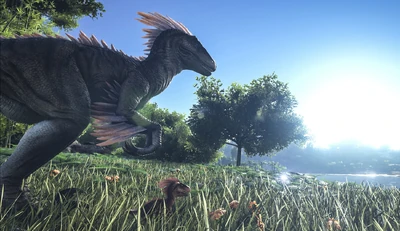
A Raptor and his offspring
Breeding is a feature of ARK: Survival Evolved that allows players to breed improved creatures through Eggs with non-mammals and gestation with mammals. Eggs do non have an owner, so it's possible to steal eggs laid past other survivors' creatures.
Newborn creatures are simply claimed (imprinted on) and do not require the usual taming processes associated with wild creatures. Anyone can claim a newborn. This must be done promptly, forth with feeding it, as babies tin can die speedily from hunger.
Contents
- one Breeding Mechanics
- 1.ane Preparing Mating
- 1.1.i Mating Requirements
- ane.i.2 Mating Range While Wandering
- 1.2 Mating
- ane.2.1 Special Weather condition of Mating
- i.ii.2 Mating Look Interval
- i.3 Incubation
- i.3.1 Managing Temperature
- 1.3.i.1 Glued Eggs
- i.3.1 Managing Temperature
- 1.four Gestating
- 1.5 Claiming
- 1.6 Caring For Babies
- 1.6.1 Caring for Infant Carnivores
- 1.half dozen.two Caring for Babies from Egg-only Tames
- 1.vi.3 Special Caring
- one.6.iii.ane Reaper Male monarch
- 1.6.iii.two Royal Griffin
- 1.six.iii.3 Beelzebufo
- 1.6.4 Food Values
- 1.7 Maturation Phases & Food Consumption
- i.vii.1 Notes
- 1.eight Imprinting
- 1.ix Sterile Creatures
- 1.ane Preparing Mating
- 2 Times for Convenance
- iii Stats of the Offspring
- 3.ane Example
- iii.ii Amount of higher stats and take a chance of obtaining them when hatching
- 3.3 Finding the Best Parents
- 3.3.1 Wild Stats Level-up
- 3.iv Level of the Offspring
- three.4.1 Example
- four Notes/Trivia
- 5 External Video Tutorials
- vi References
- 7 External links
Breeding Mechanics [ ]
Preparing Mating [ ]
The outset step of breeding is having two reverse sex creatures of the same species for mating. Original, Tek, Aberrant, Ten, and R variants of creatures count as separate species, and every bit such, cannot be cross-bred. They must be bred with their own variant. Nearly creatures can be bred; those few that cannot are listed at the bottom of this commodity. See Sterile Creatures for more data.
Ever exist prepared for having more than 1 baby to be born upon incubation/gestation completion. At that place is a x% chance of twins, and a 2% adventure of triplets.[1]
It has been confirmed that there is no beast in the game capable of affecting chances of mutations, twins and triplets.[two]
Mating Requirements [ ]
For creatures to successfully mate, they must exist:
- of same species
- of opposite sex (one male and i female)
- within mating range of each other
- wandering or set to mate (Enable Wandering or Enable Mating must be enabled on both creatures)
- not following annihilation (Disable Following on both creatures)
- unburdened (the creatures must not be carrying so much weight they are unable to motility)
- not mounted
- not spayed/neutered
- non having a mating cooldown (once mated females have a mating cooldown interval before they tin mate again, the cooldown can also be triggered when transferring the creature betwixt Arks)
Mating Range While Wandering [ ]
If using the Enable Wandering method to allow for mating, then steps demand to be taken to maintain the mating range, which varies between species and is loosely based on the size of the adult creature. If the mating pair wander outside the mating range, then mating is stopped and mating progress is reset.
Building a pen of a suitably small size to keep the wandering creatures within mating range of each other is one common arroyo.
You lot can also use the "Whistle Terminate (All)" command ( U on PC). This halts all creatures inside the area to terminate moving, even ones that are enabled to wander. Information technology's all-time to use the whistle every fourth dimension the creature starts to move again, or to prevent the creatures from ever moving, whistle constantly. While this method doesn't need a pen, it does need you or a tribe member to stay there and constantly whistle. This may be more helpful if one survivor is constantly whistling not to move, and some other survivor enables the creatures nearby to wander. In this style, you tin can accomplish mass convenance in an area without ever edifice a pen, or moving creatures.
To initiate breeding of a pair by yourself, whistle both creatures to follow yous, and so enable wandering. Then, disable following on both. This prevents them from walking effectually in the meantime.
It is possible to use the  Dino Leash
 , to restrict the range for mating. Then no mating pen is needed.
If you lot exercise not want to build a pen, whistle or utilise a leash; and so you tin can but use enable mating instead, this volition brand the creatures stand still and so they will start to mate.
Mating [ ]
When the above conditions are all met, a small red middle icon appears over the heads of the mating creatures, and a mating bar appears on the female's HUD (wait at the female to reveal the HUD). The HUD also indicates which creature they are mating with. Ensure the mating animals remain close together, as otherwise the mating stops. Due to server lag and game mechanics, the mating bar does not continuously update in existent time. Additionally, mating multiple females to a single male person at the same time tin make this worse. Patience is advised as the bar moves in leaps and bounds.
Once the mating bar is completed, non-mammalian females drop a single fertilized egg , and mammalian females start gestating.
If at that place are too many tamed creatures in the server or in the tribe, the pair will refuse to mate until in that location is a free spot.
Special Weather of Mating [ ]
Some of the creatures volition only mate when certain atmospheric condition are given.
Mating Await Interval [ ]
Females cannot mate once again until a mating wait interval has passed (Cryofreezing them will still continue the mating interval cooldown). This interval is indicated on their HUD.
The mating interval starts subsequently the creature has laid the egg or gestation has completed. The mating interval is besides started for female creatures that are transferred betwixt servers. Males can mate at whatever fourth dimension.
Incubation [ ]
- Main article: Incubation
The fertilized egg itself but begins Incubation when dropped onto the floor/ground or placed correctly in an  Egg Incubator (Genesis: Part 2). When incubating, a Fertilized Egg must exist kept at a certain temperature range depending on the species (this also factors in insulation). If outside of this temperature range, incubation won't make progress, and it loses "Fertilized Egg Health" over time and is destroyed if this reaches zero. This is all indicated on the HUD when looking at a Fertilized Egg, along with its parents.
You lot can always "pause" the incubation by picking up the egg and putting it in a  Fridge,
  Preserving Bin or other Inventory.
The following eggs are an exception due to the nature of how it is obtained (no health loss in inadequate temperature surface area):
If there are as well many tamed creatures in the server or in the tribe, the egg will continue to incubate with no timer information, but letting it hatch will not yield a baby.
Managing Temperature [ ]
The best method to ensure eggs are at an advisable temperature for incubation is through insulation. Use one or more  Air Conditioner,
  Dimetrodon,
  Kairuku or
  Otter. Six Air Conditioner should work for all eggs merely eight is ideal for when there is a rut/cold storm. Yous might need up to 14 or more Air Conditioners for larger eggs such as the
  Giganotosaurus, or the
  Wyvern in Scorched Earth or Ragnarok. The
  Rock Drake in Aberration requires at least 15 Air Conditioners due to its very cold incubation requirement. Whereas the
  Deinonychus from Valguero needs a rough 23 Air Conditioners in the snow because of its extreme rut required.
With the release of Genesis: Part two, the introduction of the Egg Incubator (Genesis: Part ii) allows for however another way to incubate eggs.
Another way is to tame a handful of Dimetrodon. These seemingly useless finned creatures are actually one of the best sources of insulation in the unabridged game. The higher their melee impairment, the higher their insulation bonus is; at ~1000 melee harm, it can even raise Wyvern eggs. The insulation effect stacks with other Dimetrodons, so if one isn't enough to practice the task, attempt two, or three, or more. Far cheaper to maintain than the expensive air conditioners, these guys are mobile and merely need meat, compared to the stationary air conditioner that also needs electricity to run. However, everything has its drawbacks: the Dimetrodon is slow and hard to transport on pes; they are difficult to tame due to where they spawn and their fast torpor drop. Withal, it is worth the take a chance, peculiarly on Aberration, where  Rock Drake Egg would unremarkably require many air conditioners.
At the get-go of the game, when the Air Conditioner or Dimetrodon are not withal bachelor, use a heat source to regulate the egg's temperature.  Continuing Torch,
  Torch,
  Campfire,
  Industrial Cooker, and
  rock fireplace work well. However, they all have the downside of providing negative Estrus Tolerance, making conscientious management necessary, or going to colder areas to make the gap between cold resistance and heat resistance bigger. You may demand four or more torches, depending on the biome and the egg.
Since temperature gradients can be very extreme between regions, easily reaching xx °C or more than, you can try and find a nearby biome where the temperature is closer to the eggs' ideal signal; this is usually in the biome that spawned the creature. Early on in the game, it is easier to find a biome that is too cold (e.1000. near the coast) and rut the egg with torches, rather than trying to cool down a hot biome.
Every bit Fertilized Eggs don't lose Egg Health in an inventory, and spoil incredibly slowly, yous tin can keep them in your Inventory or in a preserving bin/refrigerator until able to attain the appropriate temperature needed for Incubating. This tin can be very useful if you settled in a region with extreme temperatures as it'south especially difficult to cool an egg in a hot biome without an air conditioner when information technology gets besides hot.
Glued Eggs [ ]
While most creature's egg can be moved to its suitable location if the required temperature for incubation is non suited at its current location, some of the eggs cannot be moved once laid due to its glued nature. As such, females of the following eggs must lay their eggs at locations that allows incubation without causing complications:
Gestating [ ]
During gestation, females tin can consume upwards to twice the corporeality of nutrient they would commonly. Ensure the expectant mother has access to enough of food during gestation to avoid losing the baby.
The baby will need immediate attention to survive, then be sure to be there at the time the gestation ends.
Trying to put a gestating female parent into a cryopod will finish the pregnancy.
Claiming [ ]
Babies are hatched/born unclaimed, so a survivor must "merits" them immediately after birth by getting close to them, looking right at them, and pressing the "use" key ( E ,  ,
,  ) to imprint them, otherwise they can be claimed by other survivors. The simply exception is the
  Reaper King, which can only be claimed past the survivor who "gave nascency" to it; no other survivor including the birthgiver's tribe mates can merits it.
Warning: Pets assail aggressive assault unclaimed creatures as soon equally they are hatched/born. Whistle "Passive" or merits babies rapidly to avert this. Also Tek Shields will 'shunt' unclaimed babies out of their radius.
- As of 264.v, Auto Turrets and Plant Species Ten set to "Players and Tamed Creatures" volition NOT assault unclaimed creatures later they are hatched/born. Y'all can safely place turrets inside a hatching pen without fearing for babies' lives.
If babies are not very promptly claimed and then fed they tin can quickly die from hunger.
You can control the hatch timing of fertilized eggs using a Preserving Bin or Refrigerator. This is not an option for live birth creatures, so make certain to time the mating and gestation appropriately.
Caring For Babies [ ]
Young animals take significant time and intensive care, especially during the "Babe" stage; if you're busy, don't breed your creatures right abroad. Alternately, you can just put the newborn baby into a cryopod for afterward. Most creatures volition require the better part of a weekend to raise.
New babies follow the nearest survivor if one is within a reasonable range, so survivors will probably want to disable these settings. New babies have extremely low health, carrying chapters and food, so survivors need to carefully feed and take care of them in their first moments of life, or they'll shortly die. The fauna must be fed by adding food to their inventory. Once they attain Juvenile phase of their maturation (10.1%) they tin can consume from a  Feeding Trough or
  Tek Trough to ensure the creature has a sufficient food supply. The maturation progress and phase is shown when looking at the animate being.
Babies dynamically gain more HP, nutrient chapters, and carrying capacity every bit they mature over time. They demand lots of nutrient because the babies eat very quickly, and then stock upwards beforehand while the mother is pregnant/the egg is incubating.
Babies are not mountable and flee from fights. Mounts that tin conduct creatures (east.k. the  Argentavis) tin can carry babies, which allows you to quickly reposition the fiddling ones if needed.
The  Procoptodon and the
  Maewing are two creatures that tin can help with raising babies.
It takes a long fourth dimension for babies to mature; breeding should just be attempted if you or your tribe have the fourth dimension. As the baby grows, you will be able to exit the baby alone for longer and longer periods of time. One practiced utilise of a survivor's time at this stage might be crafting kibble for imprinting. If y'all will be imprinting, the baby might request any of 6 different kibbles (on PC and Panel) or 15 different kibbles (on Mobile), and so make sure you have them on manus.
Caring for Infant Carnivores [ ]
Babe carnivores are especially difficult to raise equally it takes a minimum of 48 existent hours to mature them, and a stack of meat spoils every 26.6 existent hours (40 x forty mins) in the feeding trough. Therefore their feeding trough must exist topped up every 26 hours to keep their development. Failure to exercise so could issue in starvation to death. By using Fish Meat, this time is doubled to 53,3 hours (40 x lxxx mins), although Raw Fish Meat is only half every bit nutritious equally Raw Meat, then babies will need twice as much meat. Creatures* will eat food with the lowest food value first (meet food table below), thus fish meat earlier raw meat, so mixing the ii will result in the longer keeping fish meat being eaten offset. After progression to Juvenile phase, the creatures can eat from a trough, merely will starve if not fed.
This is less of an effect for herbivores, because a stack of 100 berries lasts 66 real hours (two.7 days) before spoiling, a much more manageable interval. Remember not to try and feed the babies with stim or narcoberries because they won't consume them.
*Few creatures, like Baryonyx and Pelagornis will eat Raw Fish Meat before Cooked Fish Meat and they but eat fish meat. Similarly, their offspring volition only eat raw fish meat until reaching machismo.
The use of a powered Tek Trough that tin can shop more items and acts like a refrigerator extending the spoil time is recommended.
Caring for Babies from Egg-but Tames [ ]
Babies hatched from Egg-simply taming (with the exception of Deinonychus) simply takes a specific food until they fully matures. While their food drops down slower than other babies, feeding them with their usual food will non replenish their nutrient.
Special Caring [ ]
Some babies require special caring. Effects tin can be disastrous if non cared for properly.
Reaper King [ ]
 | This section is about content exclusive to the DLC: Aberration |
For details on taking care of babe Reaper Male monarch or how to obtain them, check its own article. Reaper Male monarch babies will attack any dino and any survivor effectually if it is able to achieve towards them and volition be constantly on wander (with no options to stop wandering or follow target). It will non assail the birth giver with  Reaper Pheromone Gland
 effect. Once it reaches Juvenile even so, information technology will stop randomly attacking and tin exist ordered like every other baby.
Whenever the baby attacks an entity, a portion of its food will be lost.
Royal Griffin [ ]
 | This section is near a feature exclusively available on Mobile |
Infant Griffins prefer to be secure to experience prophylactic. While it feels insecure, it volition refuse to swallow nutrient from inventory or trough. For information technology to experience secure, it must be close to its mother based on the current ancestor, or a female griffin with the aforementioned surname every bit the infant.
Beelzebufo [ ]
Until machismo maturity, Beelzebufo babies must always be kept inside water. Whatever attempt to pull it out fifty-fifty as Adolescent will easily kill it.
Food Values [ ]
Carnivores will just eat meat, while herbivores will only eat berries. During the babe phase, y'all have to hand feed the babe until it reaches the juvenile phase. This can take quite a long time then be prepared and have time to sit around feeding a infant.
| Food | Food-Value |
|---|---|
Preferred  Kibble Kibble | eighty (53.33*) |
Kibble fabricated from  Prime Meat Jerky (excluding Carbonemys kibble) Prime Meat Jerky (excluding Carbonemys kibble) | ninety |
| Other Kibble | 60 |
 Raw Prime Meat / Raw Prime Meat /  Raw Meat / Raw Meat /  Raw Mutton Raw Mutton | 50** |
 Spoiled Meat Spoiled Meat | fifty*** |
 Cooked Prime number Meat / Prime Meat Jerky Cooked Prime number Meat / Prime Meat Jerky | 50 |
 Crops Crops | forty |
 Mejoberries Mejoberries | 30 |
 Cooked Meat / Cooked Meat /  Cooked Meat Jerky Cooked Meat Jerky | 25 |
 Raw Prime Fish Meat / Raw Prime Fish Meat /  Cooked Prime Fish Meat / Cooked Prime Fish Meat /  Raw Fish Meat Raw Fish Meat | 25 |
 Other Berries Other Berries | 20 |
 Cooked Fish Meat Cooked Fish Meat | 12 |
* Brontos only proceeds 53.33 food points from their preferred  Kibble (Carbonemys Egg)
** some creatures accept different values for raw meat, due east.m. the  Bloodstalker gains only x for each raw meat.
*** just for  Scorpions,
  Vultures and
  Mantis.
Maturation Phases & Food Consumption [ ]
| Maturation Progress | Stage |
|---|---|
| 0%-10% | Baby |
| 10%-l% | Juvenile |
| fifty%-100% | Adolescent |
Food consumption by babies is very large and varies by the maturation progress dynamically by the following formula:
FoodPerSec = R * (1 - maturationRatio) , with R = basic food drain charge per unit
The bones food bleed rate varies per animal. For example, this value for a Rex babe is around R=i.16, while the Bloodstalker has a base of operations food bleed rate of R=0.785 (further measurements needed for other creatures).
The Rock Drake has a basic food drain of R = 0.ane, other special creatures like Wyvern and Magmasaur may take an equivalent food consumption (not tested still).
Note: This formula is an estimation and may not requite exact numbers (the error is around 5%). `maturationRatio` is the maturation percentage divided by 100.
Some Perspective: For only one infant Rex (remember you could accept twins or triplets) on an unmodified server, it will have roughly 96 stacks of raw meat (stack size twoscore) to reach developed stage, and so be certain to accept plenty on hand earlier the babe is built-in!
Utilise a figurer to make up one's mind the needed nutrient and time, e.g.[3]
Notes [ ]
- Each animate being seems to have a different food consumption charge per unit that appears to change with each phase of the maturation progress (at least for wolves and Dodos).
Imprinting [ ]
Imprinting is a way to ameliorate the stat-values of a bred creature. It requires i of iii interactions (giving specific kibble, cuddling or walking) every eight* hours. Only a single player can banner a newborn baby (whoever claims it outset). There is no punishment for non imprinting, but no gain either. Any imprinting washed is permanent. Accumulated imprinting values will non be lost if y'all miss an imprint.
If this player manages to intendance for the baby during the entire maturation, the creature'southward base of operations stats before modifications will be increased by 20% and, when ridden past the imprinter, it will also gain 30% increased damage and harm resistance.
* The time betwixt imprint and the amount of banner gained per imprint can modify if an event is happening. Keep an middle out on the HUD for when the next banner is required.
Sterile Creatures [ ]
All tameable creatures are breedable except for:
Despite in-game showing the Reaper King as breedable, information technology is impossible due to how they are "tamed", with the added fact they are shown as genderless.
In ARK: Survival Evolved Mobile,  Imperial Griffin has gender and tin can exist bred. Withal, they will only mate with members of the same business firm (they must have the same 2-3 terminal letters in their names).
Times for Breeding [ ]
| Species | Incubation Temperature | Maturation Fourth dimension [(d) h:g] | Mating Interval [h:m] | ||||||||
|---|---|---|---|---|---|---|---|---|---|---|---|
| Celsius (°C) | Fahrenheit (°F) | Visual | Fourth dimension [h:m] | Babe | Juvenile | Adolescent | Total | ||||
| Min | Max | Min | Max | ||||||||
 Allosaurus Allosaurus | 26 | 32 | 79 | 90 | one:39 | 4:37 | 18:31 | 23:08 | 1d 22:17 | 18:00–48:00 | |
 Anglerfish Anglerfish | -75 | 75 | -103 | 167 | 4:59 | 3:42 | xiv:48 | 18:31 | 1d 13:02 | 18:00–48:00 | |
 Ankylosaurus Ankylosaurus | 16 | 20 | 61 | 68 | 2:37 | 4:52 | 19:29 | 1d 00:21 | 2nd 00:43 | 18:00–48:00 | |
 Araneo Araneo | 4 | 12 | 39 | 54 | 1:25 | two:30 | ten:00 | 12:30 | 1d 01:01 | 18:00–48:00 | |
 Archaeopteryx Archaeopteryx | sixteen | twenty | 61 | 68 | ii:37 | 1:32 | 6:10 | 7:42 | fifteen:25 | 18:00–48:00 | |
| Argentavis | 12 | thirteen.5 | 54 | 56 | two:56 | v:26 | 21:47 | 1d 03:13 | 2nd 06:27 | 18:00–48:00 | |
 Arthropluera Arthropluera | xviii | 22 | 64 | 72 | two:29 | v:08 | 20:34 | 1d 01:43 | 2d 03:26 | 18:00–48:00 | |
 Baryonyx Baryonyx | 29 | 35 | 84 | 95 | ane:59 | four:37 | 18:31 | 23:08 | 1d 22:17 | 18:00–48:00 | |
 Beelzebufo Beelzebufo | 0 | 50 | 32 | 122 | 4:59 | three:42 | xiv:48 | 18:31 | 1d xiii:02 | 18:00–48:00 | |
| Bloodstalker | 27 | 30 | 81 | 86 | 2:56 | 5:26 | 21:47 | 1d 03:13 | second 06:27 | 18:00–48:00 | |
 Brontosaurus Brontosaurus | 28 | 31 | 82 | 88 | 4:59 | ix:15 | 1d 13:02 | 1d 22:17 | 3d twenty:35 | 18:00–48:00 | |
 Carbonemys Carbonemys | 30 | 34 | 86 | 93 | i:14 | 2:18 | ix:15 | 11:34 | 23:08 | 18:00–48:00 | |
 Carnotaurus Carnotaurus | 26 | 32 | 79 | xc | 1:39 | 4:37 | xviii:31 | 23:08 | 1d 22:17 | 18:00–48:00 | |
 Compy Compy | 24 | 32 | 75 | ninety | 0:49 | 2:06 | 8:25 | x:31 | 21:02 | eighteen:00–48:00 | |
 Crystal Wyvern Crystal Wyvern | 75 | 85 | 167 | 185 | iv:59 | 9:xv | 1d 13:02 | 1d 22:17 | 3d 20:35 | eighteen:00–48:00 | |
| Deinonychus | 80 | ninety | 176 | 194 | 4:59 | iii:42 | 14:48 | 18:31 | 1d 13:02 | 18:00–48:00 | |
 Dilophosaur Dilophosaur | 28 | 32 | 82 | 90 | 1:08 | 2:06 | viii:25 | 10:31 | 21:02 | eighteen:00–48:00 | |
| Dimetrodon | 30 | 34 | 86 | 93 | two:29 | 4:37 | 18:31 | 23:08 | 1d 22:17 | 18:00–48:00 | |
 Dimorphodon Dimorphodon | 35 | 38 | 95 | 100 | i:21 | 2:30 | 10:00 | 12:30 | 1d 01:01 | 18:00–48:00 | |
 Diplocaulus Diplocaulus | 0 | l | 32 | 122 | iv:59 | three:42 | 14:48 | 18:31 | 1d 13:02 | xviii:00–48:00 | |
 Diplodocus Diplodocus | 26 | 29 | 79 | 84 | 4:59 | 9:15 | 1d 13:02 | 1d 22:17 | 3d 20:35 | xviii:00–48:00 | |
 Dodo Dodo | 22 | 30 | 72 | 86 | 0:49 | i:32 | 6:10 | 7:42 | 15:25 | 18:00–48:00 | |
 Electrophorus Electrophorus | 0 | 50 | 32 | 122 | 4:59 | 4:37 | 18:31 | 23:08 | 1d 22:17 | 18:00–48:00 | |
 Featherlight Featherlight | 29 | 32 | 84 | ninety | 1:39 | four:52 | nineteen:29 | 1d 00:21 | 2d 00:43 | 18:00–48:00 | |
 Gallimimus Gallimimus | 24 | 28 | 75 | 82 | ane:25 | ii:38 | 10:34 | 13:thirteen | 1d 02:27 | 18:00–48:00 | |
| Giganotosaurus | 43 | 44 | 109 | 111 | 2d 01:59 | 1d 00:23 | 4d 01:35 | 5d 01:59 | 10d 03:59 | eighteen:00–48:00 | |
 Glowtail Glowtail | 30 | 34 | 86 | 93 | 2:29 | 4:52 | xix:29 | 1d 00:21 | 2d 00:43 | 18:00–48:00 | |
 Hesperornis Hesperornis | 22 | 30 | 72 | 86 | 1:thirty | 2:48 | xi:13 | fourteen:01 | 1d 04:03 | 18:00–48:00 | |
 Ichthyornis Ichthyornis | 29 | 32 | 84 | 90 | ane:39 | iii:42 | 14:48 | eighteen:31 | 1d 13:02 | 18:00–48:00 | |
 Iguanodon Iguanodon | 24 | 28 | 75 | 82 | one:25 | 4:37 | 18:31 | 23:08 | 1d 22:17 | xviii:00–48:00 | |
| Kairuku | 22 | 30 | 72 | 86 | 1:30 | 2:48 | xi:13 | xiv:01 | 1d 04:03 | 18:00–48:00 | |
 Kaprosuchus Kaprosuchus | 29 | 35 | 84 | 95 | 1:59 | 3:42 | fourteen:48 | xviii:31 | 1d 13:02 | eighteen:00–48:00 | |
 Kentrosaurus Kentrosaurus | 24 | 30 | 75 | 86 | two:46 | 5:08 | twenty:34 | 1d 01:43 | second 03:26 | xviii:00–48:00 | |
 Lymantria Lymantria | 35 | 38 | 95 | 100 | 1:30 | 3:05 | 12:20 | 15:25 | 1d 06:51 | eighteen:00–48:00 | |
 Lystrosaurus Lystrosaurus | 24 | 28 | 75 | 82 | 0:49 | 1:32 | six:ten | 7:42 | 15:25 | 18:00–48:00 | |
| Maewing | 22 | 26 | 72 | 79 | 1:25 | 4:37 | eighteen:31 | 23:08 | 1d 22:17 | 36:00–96:00 | |
 Magmasaur Magmasaur | 90 | 110 | 194 | 230 | iv:59 | 18:31 | 3d 02:04 | 3d 20:35 | 7d 17:11 | 18:00–48:00 | |
| Mantis | 35 | 38 | 95 | 100 | 2:46 | 5:26 | 21:47 | 1d 03:13 | second 06:27 | xviii:00–48:00 | |
 Megachelon Megachelon | -75 | 75 | -103 | 167 | 4:59 | 9:15 | 1d 13:02 | 1d 22:17 | 3d 20:35 | 18:00–48:00 | |
 Megalania Megalania | 29 | 35 | 84 | 95 | i:59 | three:42 | fourteen:48 | eighteen:31 | 1d 13:02 | 18:00–48:00 | |
 Megalosaurus Megalosaurus | 26 | 32 | 79 | 90 | ane:39 | ix:15 | 1d xiii:02 | 1d 22:17 | 3d twenty:35 | 18:00–48:00 | |
 Microraptor Microraptor | 24 | 28 | 75 | 82 | 1:25 | five:26 | 21:47 | 1d 03:13 | 2d 06:27 | 18:00–48:00 | |
 Morellatops Morellatops | 22 | 28 | 72 | 82 | two:29 | three:05 | 12:20 | xv:25 | 1d 06:51 | eighteen:00–48:00 | |
 Moschops Moschops | 16 | 20 | 61 | 68 | ii:37 | 4:52 | 19:29 | 1d 00:21 | 2d 00:43 | 18:00–48:00 | |
 Oviraptor Oviraptor | 26 | 30 | 79 | 86 | 1:08 | 2:06 | eight:25 | 10:31 | 21:02 | 18:00–48:00 | |
 Pachy Pachy | 24 | 28 | 75 | 82 | 1:25 | 2:38 | 10:34 | 13:thirteen | 1d 02:27 | xviii:00–48:00 | |
 Pachyrhinosaurus Pachyrhinosaurus | 22 | 28 | 72 | 82 | 2:29 | 4:37 | 18:31 | 23:08 | 1d 22:17 | xviii:00–48:00 | |
 Parasaur Parasaur | 24 | 28 | 75 | 82 | ane:25 | 2:38 | 10:34 | 13:13 | 1d 02:27 | eighteen:00–48:00 | |
 Pegomastax Pegomastax | 28 | 32 | 82 | 90 | 1:08 | 3:05 | 12:xx | 15:25 | 1d 06:51 | eighteen:00–48:00 | |
 Pelagornis Pelagornis | 29 | 32 | 84 | 90 | ane:39 | iii:42 | fourteen:48 | xviii:31 | 1d xiii:02 | xviii:00–48:00 | |
 Pteranodon Pteranodon | 29 | 32 | 84 | 90 | 1:39 | iii:42 | 14:48 | xviii:31 | 1d 13:02 | 18:00–48:00 | |
| Pulmonoscorpius | 12 | 16 | 54 | 61 | i:59 | iii:42 | 14:48 | 18:31 | 1d 13:02 | 18:00–48:00 | |
 Quetzal Quetzal | 5 | half-dozen | 41 | 43 | xvi:39 | xiii:13 | 2nd 04:54 | second 18:08 | 5d 12:16 | 18:00–48:00 | |
 Raptor Raptor | 20 | 28 | 68 | 82 | i:59 | 3:42 | 14:48 | 18:31 | 1d 13:02 | 18:00–48:00 | |
 King King | 32 | 34 | xc | 93 | 4:59 | 9:15 | 1d 13:02 | 1d 22:17 | 3d twenty:35 | 18:00–48:00 | |
| Stone Drake | -90 | -80 | -130 | -112 | half-dozen:14 | 9:fifteen | 1d 13:02 | 1d 22:17 | 3d 20:35 | eighteen:00–48:00 | |
 Sarco Sarco | thirty | 34 | 86 | 93 | 2:29 | 4:37 | xviii:31 | 23:08 | 1d 22:17 | xviii:00–48:00 | |
 Snowfall Owl Snowfall Owl | 12 | 13.5 | 54 | 56 | 2:56 | v:26 | 21:47 | 1d 03:thirteen | second 06:27 | 18:00–48:00 | |
 Spino Spino | 30 | 32 | 86 | 90 | iii:50 | 7:07 | 1d 04:29 | 1d eleven:36 | 2d 23:13 | xviii:00–48:00 | |
 Stegosaurus Stegosaurus | 22 | 28 | 72 | 82 | 2:46 | 5:08 | 20:34 | 1d 01:43 | 2d 03:26 | 18:00–48:00 | |
 Tapejara Tapejara | 29 | 32 | 84 | ninety | one:39 | 5:26 | 21:47 | 1d 03:13 | 2d 06:27 | 18:00–48:00 | |
 Tek Parasaur Tek Parasaur | 24 | 28 | 75 | 82 | ane:25 | two:38 | 10:34 | xiii:13 | 1d 02:27 | xviii:00–48:00 | |
 Tek Quetzal Tek Quetzal | five | 6 | 41 | 43 | xvi:39 | 13:13 | 2d 04:54 | 2d 18:08 | 5d 12:16 | 18:00–48:00 | |
 Tek Raptor Tek Raptor | 20 | 28 | 68 | 82 | 1:59 | iii:42 | fourteen:48 | 18:31 | 1d 13:02 | xviii:00–48:00 | |
 Tek Rex Tek Rex | 32 | 34 | 90 | 93 | 4:59 | 9:fifteen | 1d 13:02 | 1d 22:17 | 3d 20:35 | 18:00–48:00 | |
 Tek Stegosaurus Tek Stegosaurus | 22 | 28 | 72 | 82 | 2:46 | 5:08 | 20:34 | 1d 01:43 | second 03:26 | xviii:00–48:00 | |
 Tek Triceratops Tek Triceratops | 22 | 28 | 72 | 82 | ii:29 | four:37 | 18:31 | 23:08 | 1d 22:17 | xviii:00–48:00 | |
 Terror Bird Terror Bird | 20 | 28 | 68 | 82 | 1:59 | iv:37 | eighteen:31 | 23:08 | 1d 22:17 | eighteen:00–48:00 | |
 Therizinosaur Therizinosaur | 26 | 32 | 79 | 90 | 1:39 | xi:34 | 1d 22:17 | 2d 09:52 | 4d 19:44 | xviii:00–48:00 | |
 Thorny Dragon Thorny Dragon | 22 | 28 | 72 | 82 | 2:29 | 4:52 | nineteen:29 | 1d 00:21 | 2d 00:43 | xviii:00–48:00 | |
 Triceratops Triceratops | 22 | 28 | 72 | 82 | 2:29 | 4:37 | xviii:31 | 23:08 | 1d 22:17 | 18:00–48:00 | |
 Troodon Troodon | 28 | 32 | 82 | ninety | 1:08 | two:06 | eight:25 | 10:31 | 21:02 | 18:00–48:00 | |
 Tropeognathus Tropeognathus | 29 | 32 | 84 | 90 | 1:39 | 5:26 | 21:47 | 1d 03:13 | 2d 06:27 | xviii:00–48:00 | |
 Tusoteuthis Tusoteuthis | 0 | fifty | 32 | 122 | four:59 | 18:31 | 3d 02:04 | 3d 20:35 | 7d 17:11 | 18:00–48:00 | |
 Velonasaur Velonasaur | 28 | 32 | 82 | xc | i:08 | 4:37 | 18:31 | 23:08 | 1d 22:17 | xviii:00–48:00 | |
 Voidwyrm Voidwyrm | 80 | xc | 176 | 194 | iv:59 | 9:15 | 1d 13:02 | 1d 22:17 | 3d twenty:35 | eighteen:00–48:00 | |
| Vulture | 35 | 38 | 95 | 100 | 1:21 | ii:30 | 10:00 | 12:thirty | 1d 01:01 | xviii:00–48:00 | |
| Wyvern | 80 | 90 | 176 | 194 | iv:59 | 9:15 | 1d 13:02 | 1d 22:17 | 3d 20:35 | 18:00–48:00 | |
 Yutyrannus Yutyrannus | 32 | 34 | 90 | 93 | 4:59 | 18:31 | 3d 02:04 | 3d 20:35 | 7d 17:11 | 18:00–48:00 | |
| Species | Pregnancy [h:grand] | Maturation Time [(d) h:grand] | Mating Interval [h:m] | |||
|---|---|---|---|---|---|---|
| Infant | Juvenile | Boyish | Full | |||
 Achatina Achatina | 7:56 | ix:15 | 1d thirteen:02 | 1d 22:17 | 3d 20:35 | 18:00-48:00 |
 Astrodelphis Astrodelphis | 7:56 | 5:26 | 21:47 | 1d 03:13 | 2d 06:27 | 18:00-48:00 |
 Basilosaurus Basilosaurus | 7:56 | 11:34 | 1d 22:17 | 2d 09:52 | 4d 19:44 | 18:00-48:00 |
 Bulbdog Bulbdog | 4:x | 4:52 | 19:29 | 1d 00:21 | 2d 00:43 | 18:00-48:00 |
 Castoroides Castoroides | vii:56 | half-dozen:ten | 1d 00:41 | 1d 06:51 | second 13:43 | 18:00-39:40 |
 Chalicotherium Chalicotherium | 7:56 | 8:13 | 1d 08:55 | 1d 17:09 | 3d 10:18 | 18:00-48:00 |
 Daeodon Daeodon | vii:56 | iv:52 | xix:29 | 1d 00:21 | 2d 00:43 | 18:00-48:00 |
 Dire Bear Dire Bear | 3:58 | 4:37 | 18:31 | 23:08 | 1d 22:17 | 18:00-48:00 |
 Direwolf Direwolf | 4:10 | 4:52 | 19:29 | 1d 00:21 | second 00:43 | xviii:00-48:00 |
 Doedicurus Doedicurus | 4:57 | 5:47 | 23:08 | 1d 04:56 | 2d 09:52 | 18:00-48:00 |
 Dunkleosteus Dunkleosteus | 7:56 | 8:13 | 1d 08:55 | 1d 17:09 | 3d 10:18 | xviii:00-48:00 |
 Equus Equus | 7:56 | 4:37 | 18:31 | 23:08 | 1d 22:17 | 18:00-48:00 |
 Ferox Ferox | 9:55 | nine:15 | 1d xiii:02 | 1d 22:17 | 3d twenty:35 | xviii:00-48:00 |
 Gacha Gacha | 7:56 | 11:34 | 1d 22:17 | 2d 09:52 | 4d 19:44 | eighteen:00-48:00 |
 Gasbags Gasbags | 7:56 | iv:37 | 18:31 | 23:08 | 1d 22:17 | 18:00-48:00 |
 Gigantopithecus Gigantopithecus | vi:36 | 7:42 | 1d 06:51 | 1d xiv:34 | 3d 05:09 | 18:00-48:00 |
 Hyaenodon Hyaenodon | 3:58 | 4:37 | 18:31 | 23:08 | 1d 22:17 | 18:00-48:00 |
 Ichthyosaurus Ichthyosaurus | 7:56 | 5:47 | 23:08 | 1d 04:56 | 2nd 09:52 | 18:00-48:00 |
 Jerboa Jerboa | 2:38 | 2:06 | eight:25 | 10:31 | 21:02 | xviii:00-48:00 |
 Mammoth Mammoth | vii:56 | viii:thirteen | 1d 08:55 | 1d 17:09 | 3d 10:18 | xviii:00-48:00 |
 Managarmr Managarmr | 3:58 | 9:15 | 1d xiii:02 | 1d 22:17 | 3d 20:35 | eighteen:00-48:00 |
 Manta Manta | 7:56 | 3:42 | 14:48 | xviii:31 | 1d thirteen:02 | 18:00-48:00 |
 Megaloceros Megaloceros | 6:06 | seven:07 | 1d 04:29 | 1d 11:36 | 2d 23:13 | eighteen:00-48:00 |
 Megalodon Megalodon | half dozen:06 | vii:07 | 1d 04:29 | 1d 11:36 | 2d 23:thirteen | 18:00-48:00 |
 Megatherium Megatherium | seven:56 | nine:15 | 1d 13:02 | 1d 22:17 | 3d 20:35 | 18:00-48:00 |
 Mesopithecus Mesopithecus | 2:38 | iii:05 | 12:20 | 15:25 | 1d 06:51 | xviii:00-48:00 |
 Mosasaurus Mosasaurus | 7:56 | 18:31 | 3d 02:04 | 3d 20:35 | 7d 17:11 | 18:00-48:00 |
 Onyc Onyc | 3:58 | 2:48 | 11:13 | xiv:01 | 1d 04:03 | 18:00-48:00 |
| Otter | seven:56 | 2:06 | viii:25 | 10:31 | 21:02 | 18:00-39:twoscore |
 Ovis Ovis | 4:10 | 4:52 | 19:29 | 1d 00:21 | 2d 00:43 | 18:00-48:00 |
 Paraceratherium Paraceratherium | seven:56 | 9:15 | 1d 13:02 | 1d 22:17 | 3d 20:35 | xviii:00-48:00 |
 Phiomia Phiomia | ix:55 | 4:52 | 19:29 | 1d 00:21 | second 00:43 | 18:00-48:00 |
 Plesiosaur Plesiosaur | 7:56 | 11:34 | 1d 22:17 | 2d 09:52 | 4d 19:44 | 18:00-48:00 |
| Procoptodon | three:58 | 4:37 | 18:31 | 23:08 | 1d 22:17 | 18:00-48:00 |
 Purlovia Purlovia | iv:10 | iv:52 | nineteen:29 | 1d 00:21 | 2d 00:43 | 18:00-48:00 |
 Ravager Ravager | 4:10 | iv:52 | 19:29 | 1d 00:21 | 2d 00:43 | 18:00-48:00 |
| Reaper Male monarch | 12:00 | seven:42 | 1d 06:51 | 1d xiv:34 | 3d 05:09 | - |
 Scroll Rat Scroll Rat | 4:57 | 5:47 | 23:08 | 1d 04:56 | 2nd 09:52 | 18:00-48:00 |
 Sabertooth Sabertooth | iv:10 | 4:52 | 19:29 | 1d 00:21 | 2d 00:43 | 18:00-48:00 |
 Shadowmane Shadowmane | 2:23 | 4:52 | 19:29 | 1d 00:21 | 2d 00:43 | 18:00-48:00 |
 Shinehorn Shinehorn | 4:ten | 4:52 | 19:29 | 1d 00:21 | 2d 00:43 | 18:00-48:00 |
 Thylacoleo Thylacoleo | 4:ten | four:52 | 19:29 | 1d 00:21 | 2nd 00:43 | 18:00-48:00 |
 Unicorn Unicorn | seven:56 | iv:37 | 18:31 | 23:08 | 1d 22:17 | 18:00-48:00 |
 Woolly Rhino Woolly Rhino | three:58 | v:47 | 23:08 | 1d 04:56 | 2d 09:52 | xviii:00-48:00 |
Stats of the Offspring [ ]
The spawn of 2 dinosaurs volition inherit the "natural" stat levels of its parents. Natural stat levels are the levels in each stat after it has been tamed but before it gains any stats through leveling-up by a player. There is a 55% hazard of inheriting the stronger stat of each parent. This means you take a sure percent run a risk of obtaining a 100% perfect (meaning with only the higher stats of both parents) creature from both parents from each mating.
The stat-values (not the stat-levels) of the offspring are calculated like for a fauna that was only tamed with a 100% taming effectiveness with the taming effectiveness bonuses practical. This means that an offspring can have college values than its parents in stats that go a bonus from taming effectiveness (for most creatures this is Melee Impairment and sometimes Food). Come across also Creature stats calculation for how the values are calculated from the stats.
Example [ ]
To understand this amend, here is an example. Let's only look at the melee damage of a pair of Raptors. Assume they were just tamed with a taming effectiveness of lxx% and have both already 4 levels in melee impairment. The value you lot can see every bit melee impairment is according to the formula on Beast stats calculation, the newly added extra modifier (balancing update), and the stats of the raptors
Value = (BaseStat × ( 1 + LevelWild × IncreaseWild) + TamingBonusAdd × TamingBonusAddModifier) × (one + TamingEffectiveness × TamingBonusMult × TamingBonusMultModifier) Value = (100% × ( 1 + 4 × 5%) + 50% × 15%) × (1 + 70% × 40% × 45%) Value = 127.5% × 112.6% Value = 143.6%
The offspring inherits the values of its parents. But they don't inherit the plain value, but the levels the parents spend in the stats before existence leveled up by a player. So the offspring inherits 4 levels for its melee damage (as both parents have 4 levels in this instance). To get the value of the melee damage of the offspring, we summate information technology like before, but this fourth dimension we use a taming effectiveness of 100% (this is the fashion the game gives you lot some other bonus if y'all breed creatures).
Value = (BaseStat × ( one + LevelWild × IncreaseWild) + TamingBonusAdd × TamingBonusAddModifier) × (ane + TamingEffectiveness × TamingBonusMult × TamingBonusMultModifier) Value = (100% × ( one + 4 × 5%) + l% × 15%) × (1 + 100% × 40% × 45%) Value = 127.5% × 118% Value = 150.5%
The offspring has similar the parents four levels in melee damage, merely with the higher taming-effectiveness-bonus its value is 150.5% instead of 143.6%. The bonus is not much, only is clearly noticeable.
Amount of higher stats and chance of obtaining them when hatching [ ]
| Number of desired Stats | Probability [%] |
|---|---|
| six | 2.77% |
| 5 | thirteen.59% |
| 4 | 27.80% |
| 3 | 30.32% |
| two | 18.61% |
| 1 | 6.09% |
| 0 | 0.83% |
Finding the Best Parents [ ]
To maximize the stats of the offspring, specialized parents with a good value in few stats are needed. The more specialized a creature is in one stat, the college it can be. To get a really good breed you need half dozen creatures, each with a loftier upleveled (merely the wild-leveling counts hither) unlike stat. Afterwards at least iii generations a fauna with the best of the stats can be bred.
Wild Stats Level-up
Type in values of a wild animal to see on which stats it's emphasized. Green values on a high-level animal are very skillful for breeding. If you have already tamed your creature you tin can try to recover the breeding stats with an external tool.[4]
Breeding
The stat-reckoner does not piece of work in the mobile-view, see here for alternatives: Apps
Note that after the creature is tamed it gets bonuses on some stats depending on the taming effectiveness. This makes information technology hard to retrieve the levels on a tamed creature, then this tool is only for wild ones, but gives a first impression, how well the stats are distributed.
Level of the Offspring [ ]
The resulting level of the baby is the sum of wild level-points (i.eastward. level of the creature directly after taming) spent in the inherited stats by its parents. Assume for instance, that one (highly unusual) parent has merely leveled up in Health xl levels and nothing else, while the other parent leveled upwardly only in weight 30 levels. If the baby happens to inherit these college stats, it inherits 70 levelups giving it level 71 with its starting level. Other possibilities are a level 41 Baby with only wellness leveled upwards, a level 31 baby with only weight leveled up or a baby with level 1 and nada leveled upward.
The (practically impossible to reach) maximum of levels a babe tin become would be 223 levelups (149 natural + 74 by taming bonus (TE of nearly 100%)) in each stat, with 7 stats summing upwards to level 1562 (223 levelups in vii stats plus the startinglevel: 223 x seven + one = 1562).
One would demand to find an average of 2.863×10^188 number of any fauna to go all 223 wild stats put into any specific stat, assuming all levels have the same risk of spawning [1/((i/vii)^223)].
Note that the levels a wild brute wastes in the motion stat is remembered and passed on during breeding. Thus 2 siblings with seemingly identical stats might have different levels if one of them inherited a higher motion stat than the other. This has i practical advantage: a higher torpor level.
Annotation that the cap level of beast on official are 450, subsequently this level your beast volition be deleted by server restart, transferring or if you lot cryo pod information technology.
Case [ ]
Here's an example of two parents and possible children they can get. Child1 inherited random stats, ChildMax only got the maximum values and ChildMin only got the lower values. You lot tin can come across that the level of the offspring can be lower, in between or higher as the levels of the parents. The higher levelup is displayed in bold.
Displayed are merely the wild levels (the ones that can be inherited). Levelups past the actor have no influence on the stats of the offspring.
In this example the levels of Stamina are the aforementioned for both parents, so y'all cannot tell which ane the offspring inherited.
| Mother | Child1 | ChildMax | ChildMin | Begetter | ||||||||||||||||||||||||||||||||||||||||||||||||||||||||||||||||||||||||||||||||
|---|---|---|---|---|---|---|---|---|---|---|---|---|---|---|---|---|---|---|---|---|---|---|---|---|---|---|---|---|---|---|---|---|---|---|---|---|---|---|---|---|---|---|---|---|---|---|---|---|---|---|---|---|---|---|---|---|---|---|---|---|---|---|---|---|---|---|---|---|---|---|---|---|---|---|---|---|---|---|---|---|---|---|---|---|
Level 154
| Level 150
| Level 166
| Level 130
| Level 142
|
To get to the beast'due south level, you lot add up the levels of the stats and add one, every bit all creatures start at level one.
Notes/Trivia [ ]
- Contrary to popular myths, the Oviraptors and Unicorns do non increment chances for twins, triplets nor mutations.
- The
 Titanoboa,
  Basilisk,
  Coelacanth,
  Piranha,
  Sabertooth Salmon,
  Karkinos,
  Dung Beetle,
  Astrocetus,
  Lamprey and
  Trilobite cannot be bred when domesticated.
 - All the same, in the real world all reptiles, fish, crustaceans, snails, whales, and Trilobites and Dung Beetles are able to breed.
External Video Tutorials [ ]
References [ ]
- ↑ Patch notes, v220
- ↑ ComplexMinded's tweet, dated Mar four, 2020
- ↑ Crumplecorn'south Breeding Calculator
- ↑ ARK Smart Convenance
External links [ ]
- Ark Breeding Calculator (Web Application)
| Gameplay Mechanics | |||||||||||||||
|---|---|---|---|---|---|---|---|---|---|---|---|---|---|---|---|
| Games/Franchises | ARK: Survival Evolved (Mobile) • PixARK • ARK Park • ATLAS • ARK ii | ||||||||||||||
| Building & Development | Edifice • Edifice Guides • Farming • Cooking • Electricity • Detail Quality • Spoilage • Blueprints • Inventory • Tribes • Spawn Locations • Leveling • Creative Mode | ||||||||||||||
| Items | Armor • Consumables • Resource • Structures • Weapons | ||||||||||||||
| Environment | Game Modes • Single Player • Survival of the Fittest • Game Persistence • Ecology • Difficulty | ||||||||||||||
| Exploring |
| ||||||||||||||
| Graphic symbol |
| ||||||||||||||
| Creatures |
| ||||||||||||||
| Miscellaneous | Achievements • Chat • DLCs • Weapon Mechanics • Stasis • Raptor Claus • HLN-A • Chibi-Pets | ||||||||||||||
Source: https://ark.fandom.com/wiki/Breeding
0 Response to "X2 Ark When Raising Babies Expires Change Rate"
Post a Comment